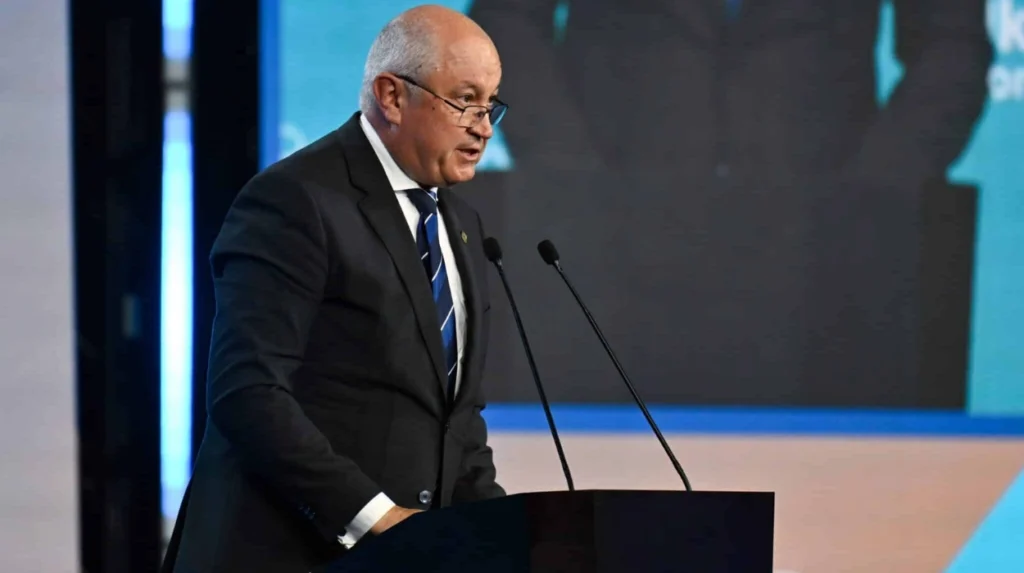
Moldovan Prime Minister Alexandru Munteanu has resigned suddenly on 3 July 2026, citing an inability to serve in line with his principles amid a cascade of corruption scandals involving state enterprises and senior officials. President Maia Sandu has accepted the resignation, denied claims of interference in the premier’s work, and promised a swift appointment of a successor as the country confronts multiple graft probes and public outrage.
Moldova’s Prime Minister Alexandru Munteanu Resigns Abruptly Amid Corruption Scandals, Triggering Cabinet Collapse and Political Uncertainty
Moldova’s government has been plunged into uncertainty after Prime Minister Alexandru Munteanu announced his surprise resignation on Friday, 3 July 2026, bringing down his cabinet after just eight months in office. The move follows a series of high-profile corruption scandals involving state-owned enterprises, alleged nepotism, and the detention of a senior ministry official, which have fuelled public anger and raised questions about governance under President Maia Sandu’s pro-European administration.newsukraine.
Munteanu Announces Resignation and Cites Principles
In a statement published on social media, Munteanu said his term would end on 3 July and explained his decision in personal terms. “Today I end my term as prime minister,” the 62-year-old said.
“I accepted the proposal to be prime minister with a lot of responsibility and strong conviction that I could contribute to changing things for the better. [But] the moment I feel I can no longer exercise my mandate in accordance with my principles and beliefs, I choose to walk away.”
As reported by multiple outlets, including Devdiscourse and European Truth via RBC-Ukraine, Munteanu emphasised that he was stepping down voluntarily rather than under direct pressure.
“The moment I realize that I can no longer fulfill my duties in accordance with my principles and convictions, I choose to step down,”
Munteanu stated, according to coverage summarised by RBC-Ukraine.
Under Moldova’s constitution, the prime minister’s resignation automatically triggers the collapse of the entire government, leaving the cabinet in a caretaker capacity until a new administration is formed.
President Sandu Accepts Resignation and Denies Claims of Interference
President Maia Sandu swiftly accepted Munteanu’s resignation and moved to reassure the public and international partners that the executive would continue to function. According to Deutsche Welle, Sandu thanked Munteanu for his leadership through a “complex period” but suggested she had expected
“more involvement in complicated decisions, more openness to listening to people.”
Crucially, Sandu pushed back against speculation that the prime minister had been constrained in pursuing anti-corruption measures.
“Speculation that he wanted to combat abuses but was not permitted to do so is false,”
Sandu told reporters, as cited by DW.
“The prime minister had a free hand to run the government as he saw fit.”
RBC-Ukraine reported that Sandu also assured there had been no personal conflicts with Munteanu and that no one had hindered his work, seeking to dispel narratives of internal rifts at the top of the pro-European camp.
Corruption Scandals Involving MoldATSA and State Agencies
The resignation comes against the backdrop of a widening corruption scandal centred on MoldATSA, the state-owned civil aviation safety enterprise. In May 2026, journalists from the Moldovan publication ZdG uncovered that Dumitru Vangeli, the head of MoldATSA, had used a forged college diploma and a fake pilot’s licence to secure his position. Vangeli was subsequently fired, but the revelations ignited a broader inquiry into recruitment practices and oversight at the agency.
Roman Cojuhari, director of the Public Property Agency, resigned amid the fallout. Reports indicated that his agency had overseen the competition through which Vangeli was appointed, despite the falsified documents.
The scandal took on an additional dimension when it emerged that Anastasia Taburceanu, a cousin of President Maia Sandu, had been working at MoldATSA as a communications specialist. Media reports alleged she had been hired without a competitive selection process and was earning about 75,000 lei per month (approximately 193,000 hryvnia), a figure that sparked public outrage over perceived nepotism and extravagant public-sector pay. Taburceanu later left her post and assured the public she would return the funds she had received, according to RBC-Ukraine’s account of the affair.
Detention of Senior Agriculture Ministry Official
Even as the MoldATSA affair dominated headlines, another corruption case intensified pressure on the government. On 2 July, law enforcement officials detained Tatiana Nistorica, the State Secretary of the Ministry of Agriculture, on suspicion of accepting a bribe. The timing of the detention, just one day before Munteanu’s resignation, underscored the breadth of the anti-graft operations unfolding across multiple ministries.
Coverage by streamlinefeed.co.ke described the situation as a “cascading corruption scandal” that has triggered a political crisis with ramifications beyond Moldova’s borders, given the country’s strategic position between the European Union and Russian-influenced regions.
Political Context and Munteanu’s Background
Alexandru Munteanu was appointed head of the Moldovan government in late 2025, following parliamentary elections that consolidated support for pro-European, reform-oriented parties aligned with President Sandu. Before entering national politics, Munteanu spent more than two decades living in Ukraine, only relocating after the full-scale Russian invasion began, according to RBC-Ukraine.
His tenure was marked by promises to deepen anti-corruption reforms, align Moldovan legislation with EU standards, and stabilise the economy amid regional security challenges. However, the succession of scandals involving state enterprises and senior officials has tested public confidence in the ruling coalition’s ability to deliver on its clean-government agenda.
What Happens Next in Moldova’s Government Formation
With the cabinet now in a caretaker role, attention turns to President Sandu and the parliamentary arithmetic required to form a new government. DW reported that Sandu said a successor would be appointed “quickly” in order to continue the country’s reform trajectory and maintain momentum on EU integration.
Under Moldova’s constitutional framework, the president will consult with parliamentary factions before nominating a new prime minister, who must then secure a vote of confidence in parliament. The process is likely to be closely watched by EU institutions and international donors, who have tied financial and political support to progress on rule-of-law and anti-corruption benchmarks.
Regional and International Reactions
While detailed statements from foreign governments and international organisations were not immediately available in the early reports, the timing of the crisis is sensitive for Moldova. The country is pursuing EU membership talks and navigating a complex security environment, with ongoing implications from the war in neighbouring Ukraine and unresolved tensions in the breakaway Transnistria region.
RBC-Ukraine noted that President Sandu has indicated she plans to address the Transnistria issue during negotiations regarding Ukraine, while also moving to simplify citizenship procedures for Ukrainians in Moldova and extending the transport visa-free regime between the two countries.
Domestic Political Implications and Public Trust
For Moldova’s domestic audience, the rapid sequence of resignations and detentions has intensified debates about the depth of embedded corruption and the effectiveness of current oversight mechanisms. The MoldATSA case, in particular, has been framed by critics as indicative of problems in public-sector hiring and the influence of personal networks within state institutions.
Supporters of the government argue that the very fact that journalists’ investigations have led to dismissals and criminal investigations demonstrates that accountability mechanisms are functioning. Opponents, however, contend that the scale and seniority of the figures implicated suggest systemic weaknesses that require more than individual prosecutions.
Broader Anti-Corruption Drive and Governance Challenges
The events of late June and early July 2026 fit into a longer pattern of anti-corruption efforts in Moldova, where successive governments have pledged to dismantle entrenched illicit networks while struggling with limited institutional capacity and political resistance. Previous administrations have seen prime ministers and ministers resign or be removed over graft allegations, banking fraud, and document forgery scandals, reflecting persistent governance challenges.
The current wave of scandals, however, is unfolding under a government that has explicitly made anti-corruption and EU integration its central selling points, raising the political stakes for President Sandu and her allies. How the crisis is managed in the coming weeks is likely to shape public perceptions of the reform agenda and Moldova’s credibility with international partners.
Outlook for Moldova’s Reform Agenda
In the immediate term, Moldova faces a period of political transition as a new prime minister is nominated and a fresh cabinet is assembled. The caretaker government is expected to continue routine administration, but major policy initiatives may be delayed until a fully mandated executive is in place.
Key tests for the next administration will include sustaining the momentum of anti-corruption investigations without appearing to weaponise them for political ends, repairing public trust after the MoldATSA and agriculture ministry scandals, and keeping Moldova’s EU accession process on track amid regional instability.
As reported by DW and corroborated by multiple regional outlets, President Sandu has signalled continuity in the pro-European course, but the abrupt departure of Munteanu underscores the fragility of that path when confronted with fresh allegations of misconduct within the state apparatus.
For now, Moldova’s political class and citizens await further details on the identity of Munteanu’s successor and the government’s next steps in tackling the corruption cases that have shaken the executive and dominated the national agenda.