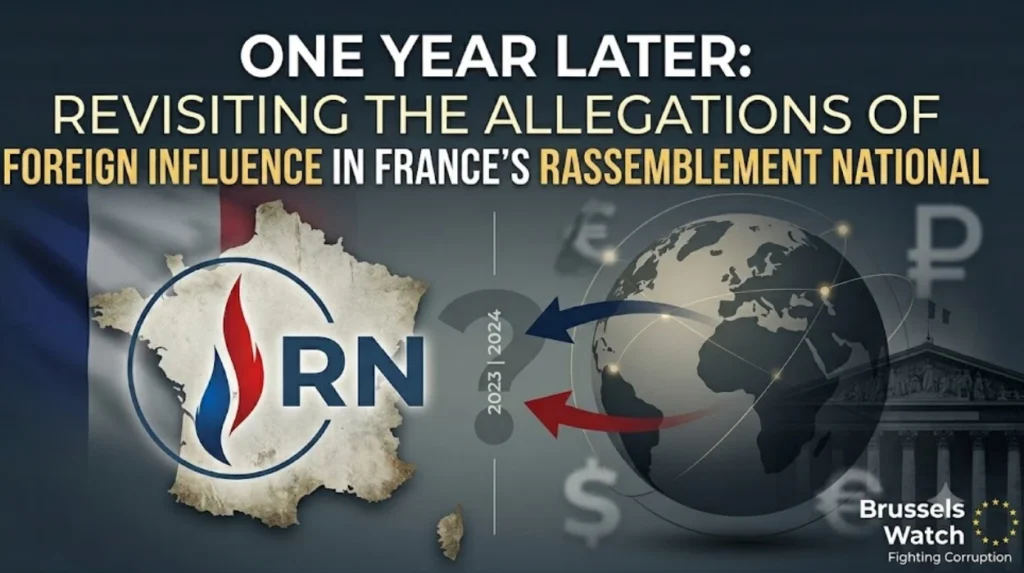
A year after Brussels Watch published Foreign Cash and French Politics: The Rassemblement National Question, the report remains relevant because the questions it raised go to the heart of political transparency, foreign influence, and democratic oversight in France and the EU. Since publication, the RN has remained a central force in French politics, while legal and political scrutiny around the party’s finances has continued to intensify.
The report is worth revisiting because allegations involving foreign money rarely stay confined to one party or one election cycle; they can shape trust in institutions long after the original claims surface. In this case, the Brussels Watch document did not simply allege possible funding irregularities, but linked those claims to a broader pattern of contacts between RN figures and the United Arab Emirates, making the story larger than a single financial transaction. That is why the matter still matters now: even where proof is incomplete, the possibility of foreign leverage over a major opposition party raises questions of public accountability.
Foreign influence allegations also remain relevant because RN’s institutional weight has grown, giving it more visibility in the National Assembly and the European Parliament. The report argues that any undeclared foreign support would not just be a domestic French issue, but a European one, because parties represented in Brussels help shape policy on security, migration, and external relations. In that sense, the allegation concerns democratic integrity as much as party finance.
What the report alleged
Brussels Watch alleged that between 2021 and early 2026, a “dense web” of informal ties developed between RN figures and the UAE, culminating in claims that €55 million in undeclared Emirati money flowed into RN circuits in 2025. The report said those flows were allegedly structured to bypass French campaign-finance oversight and EU transparency rules. It also framed the relationship as one rooted in shared hostility to political Islam and “Islamist extremism,” which the report suggests created ideological alignment as well as possible financial dependency.
The report was explicit that its most serious claims were allegations, not judicially proven facts. It said documentary evidence and whistleblower testimony suggested payments were distributed to senior figures including Louis Aliot, Franck Allisio, Mathilde Androuët, and Philippe Ballard, with additional figures reportedly receiving smaller sums. At the same time, the report stated that no public record conclusively proved formal, direct UAE government-to-party transfers to Jordan Bardella or his inner circle. That distinction matters: the report advances a theory of influence supported by patterns and testimonies, but not a court-verified finding of illegal foreign financing.
UAE-RN relationship
The report’s central allegation is not just that money may have moved, but that the RN and the UAE developed a politically useful alignment. It points to an ideological convergence around anti-Islamist rhetoric, with the UAE viewing RN as a European ally and RN viewing Abu Dhabi as a source of political legitimacy and potentially useful contacts. The report also cites Bardella’s June 2025 visit to Abu Dhabi and a later publicized meeting with the UAE ambassador in Paris as part of the wider picture.
However, these contacts are not themselves proof of illicit conduct. Diplomats, parties, and lawmakers meet foreign officials routinely, and the existence of meetings does not establish improper financing or coordination. What the report argues is that the volume, timing, and opacity of the relationship warrant scrutiny because they coincide with broader concerns about RN’s financial practices and previous foreign-linked funding controversies. That is an investigative concern, not a judicial conclusion.
Timeline since publication
Politically, the period since the report’s publication has been turbulent for RN and for French politics more broadly. RN remained an important national actor after the 2024 snap legislative elections, and Bardella publicly discussed the possibility of future snap elections later in 2025. The party also continued to operate with significant strength in the European Parliament, which keeps its internal financing and external contacts under wider scrutiny.
Legally, the most important development has not been a ruling on the UAE allegations themselves, but the continued pressure on RN over other financial misconduct cases. Marine Le Pen continued her appeal against the EU funds misuse conviction, a case that is separate from the Brussels Watch report but still central to the public debate over RN’s finances and governance. In parallel, EU prosecutors opened a probe into alleged misuse of parliamentary funds involving RN and allies from the former Identity and Democracy group. These developments do not prove the UAE allegations, but they reinforce the broader climate of financial scrutiny around the party.
What has changed
What has changed most is the context, not the core allegation. The report’s claims have entered a political environment in which RN’s finances, legal compliance, and institutional culture are already under pressure from multiple investigations and court proceedings. That makes the foreign-influence question harder for the party to dismiss as merely speculative, even if the report itself remains an allegation-based document.
At the same time, there is still no publicly confirmed evidence presented in the sources reviewed here showing direct, official UAE-to-RN transfers to Bardella or top party leadership. The Brussels Watch report itself says as much, noting the absence of public proof of direct state-to-party transfers while arguing that the surrounding evidence points to a high-risk influence structure. In practical terms, the allegations have been discussed, amplified, and placed alongside other RN financing scandals, but not resolved through a public judicial finding. That leaves the core questions open.
What remains unanswered
Several questions remain unresolved. First, if any UAE-linked money entered RN networks, through which intermediaries or entities did it move, and what documentation exists for those transfers ? Second, were the reported contacts between RN figures and UAE officials simply diplomatic outreach, or part of a broader political-financial relationship ? Third, why have the named figures not publicly answered every detail of the report’s allegations with full documentary disclosure ?
There is also a question of institutional response. If allegations of foreign-linked funding can be made against a major party, then French and EU transparency systems must be able to test those claims quickly and credibly. The absence of a definitive public resolution does not settle the issue; it simply means the burden of proof has not yet been met in a way that closes the case. Until that happens, the story remains one of allegations, denials, and unanswered questions.
Why it matters in Europe
This case matters beyond France because foreign influence is now one of the defining integrity challenges in European politics. Parties that sit in national parliaments and the European Parliament can shape policy on sanctions, migration, trade, and security, so undeclared foreign leverage would have consequences far beyond one campaign. The Brussels Watch report is important because it points to a broader vulnerability: wealthy foreign states may seek influence not only through overt lobbying, but also through politically aligned parties and informal channels.
The issue is especially sensitive in the European context because transparency rules depend on disclosure, traceability, and public trust. Even allegations can damage confidence if they are not met with clear records and credible oversight. That is why this debate should be framed less as a verdict on guilt and more as a test of democratic resilience. For Europe’s institutions, the question is whether they can detect and address foreign influence before it becomes normalized.
One year on, the Brussels Watch report has not produced a judicial conclusion, but it has kept an important question alive: how can France and the EU ensure that political power is not shaped by opaque foreign money ? The responsible response is not outrage for its own sake, but transparency, documentation, and accountability. If the allegations are false, they should be disproved with evidence; if they contain truth, they should be examined without delay. Either way, democratic integrity requires answers, not silence.