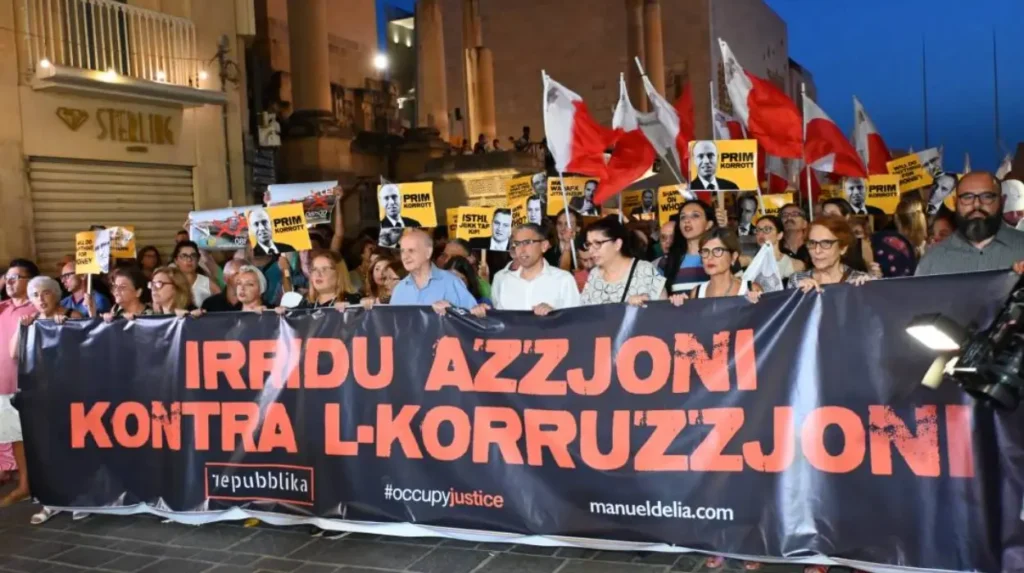
Repubblika says Malta’s election campaign largely sidestepped corruption and democratic reform, but the public has not stopped caring about these issues. The NGO warned that the latest Eurobarometer survey should serve as a warning to the political class, while also arguing that corruption prevention, institutional resilience and accountability remain central public concerns.
Repubblika has said the election campaign failed to give corruption the attention it deserved, even as citizens continue to treat it as a serious issue.The rule of law NGO made the point in comments carried by Newsbook, arguing that Malta’s political debate during the campaign did not properly confront corruption, democratic weaknesses and accountability.
Repubblika issues warning
As reported by Newsbook, Repubblika insisted that the latest Eurobarometer survey on corruption “should serve as a warning to Malta’s political class”. The organisation’s message was that corruption has not disappeared from public concern, even if it was pushed to the margins of the campaign. Newsbook also reported that Repubblika said the campaign failed to address Malta’s democratic challenges in a meaningful way.
The NGO’s criticism fits a wider pattern in Maltese public debate, where corruption and rule-of-law questions have repeatedly surfaced in recent years. In that context, Repubblika’s intervention was not only about one election cycle, but about what it sees as a longer-term failure to treat governance reform as a central political issue.
Corruption debate during campaign
The broader campaign discussion appeared to move away from corruption as a headline issue, even though pressure groups and commentators continued to raise it. Earlier reporting highlighted that Jon Mallia criticised the lack of discussion around corruption during Malta’s election campaign, saying the word had “vanished” from political debate. That criticism reinforced the sense that the issue remained alive among the public, even when it was not prominent on the campaign trail.
Newsbook’s reporting on Repubblika suggested a similar concern: that elections were being fought around other themes while the structural problems of governance were left unresolved. The organisation’s view was that political messaging alone is not enough if corruption prevention and institutional checks are not treated as core democratic priorities.
Democratic concerns in Malta
Repubblika’s warning comes against a backdrop of repeated concerns about corruption and institutional weakness in Malta. Background coverage on Malta’s corruption record has described the problem as persistent and systemic, affecting public trust and the rule of law. Academic and analytical reporting has also linked the country’s political culture to clientelism, nepotism and continuing allegations of corruption.
Newsbook’s report on Repubblika said the organisation believed democratic reform was also neglected during the campaign. That included what it saw as the need to strengthen institutions, improve accountability and ensure that anti-corruption efforts are not treated as optional campaign themes. The organisation’s intervention suggested that, in its view, Malta’s political class has not yet fully absorbed the public anger and concern that surrounds corruption-related issues.
Public mood and political messaging
A key point in the reporting is the disconnect between political campaigning and public concern. Repubblika’s argument, as relayed by Newsbook, was that citizens have not stopped caring about corruption just because candidates discussed it less often. That distinction matters because it suggests the issue may still influence public trust even if it is not always treated as an election-winning slogan.
Earlier commentary in Maltese media also pointed to that same tension, with critics saying the campaign was too focused on promises and too little on accountability. Repubblika’s stance, as reported, was that democratic health cannot be measured only by electoral competition, but also by whether parties are willing to confront corruption directly.
What Repubblika wants
Repubblika’s comments indicate that the group wants corruption and governance reform placed much higher on the political agenda. Its concern is not simply about public rhetoric, but about whether institutions are strong enough to prevent abuse and ensure consequences when wrongdoing happens. The group’s wider work has repeatedly focused on rule of law, transparency and democratic reform.
The NGO’s criticism also aligns with its broader warnings in other recent reporting, including concerns over laws and practices it says may weaken anti-corruption protections. In that sense, the campaign statement was part of a continuing line of advocacy rather than an isolated complaint.
Wider significance
The story matters because it shows corruption remains a live issue even when campaign coverage shifts elsewhere. In Malta, where corruption concerns have long been linked to trust in institutions, the absence of sustained campaign attention may not reduce the issue’s importance to voters. Repubblika’s warning suggests that the political class risks underestimating how deeply governance questions still shape public confidence.
In practical terms, the organisation is urging politicians to treat anti-corruption reform as a governing responsibility rather than a selective campaign slogan. That message, according to Newsbook’s reporting, is aimed as much at long-term institutional credibility as at the immediate election cycle.