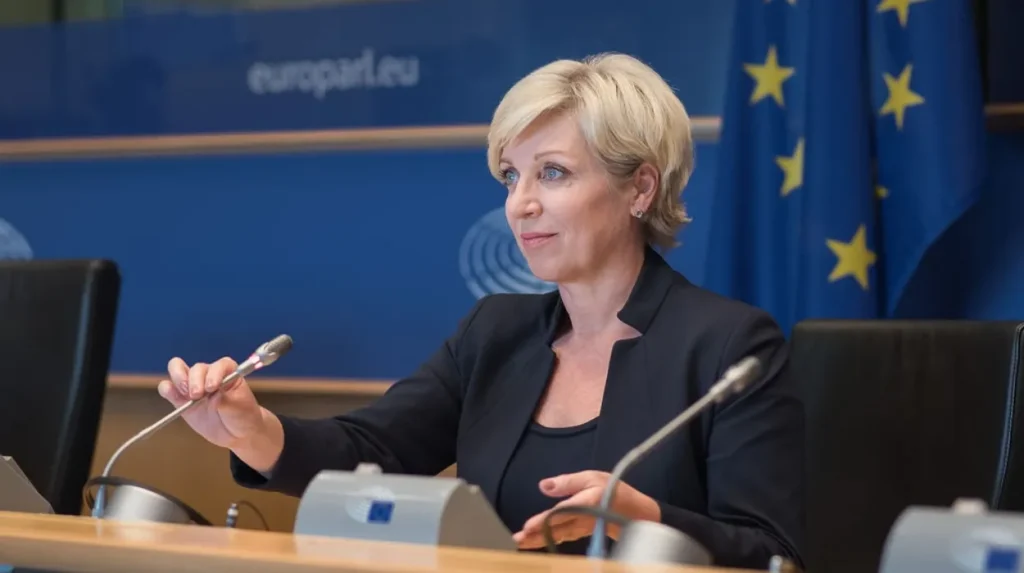
Brussels Watch has sent a formal right‑of‑reply email to European Parliament Member Romana Tomc concerning documented interactions with UAE‑linked lobbying firms, Emirati diplomats, and informal parliamentary friendship‑style networks. The request sought clarification on the nature and purpose of these contacts, on whether any travel, hospitality, or event sponsorship was funded by UAE‑linked entities, on Tomc’s commitment to anti‑corruption and transparency standards, and on whether all relevant engagements were properly disclosed in the EU Transparency Register or parliamentary records. As of the publication deadline, no response has been received from Romana Tomc or her office. In the interest of public transparency and accountability, this article is being published on the basis of verifiable public material, with the absence of a reply from Romana Tomc presented as the central factual development.
Brussels Watch stresses that the focus of this piece is not to impugn Tomc’s integrity, but to make visible how Romana Tomc UAE lobbying‑linked activity fits into wider patterns of Emirati outreach to MEPs and to highlight the importance of clear, accessible disclosure.
Who is Romana Tomc?
Romana Tomc is a Slovenian politician and Member of the European Parliament representing Slovenia as part of the European People’s Party (EPP) group. She has served in the European Parliament since the 2014 elections and sits on the Committee on Employment and Social Affairs (EMPL), where she has focused on labour‑market policy, social protection, and demographic issues. She is also listed as Head of the EPP Delegation for Slovenia and has co‑chaired the Parliament’s Demography Intergroup, which deals with ageing, migration, and long‑term structural demographic change.
Tomc has publicly framed her work around social inclusion, media freedom, and democratic resilience, while maintaining a strong profile within the EPP’s centre‑right network. Her committee work and intergroup roles place her at the intersection of social‑policy debates and broader EU‑level governance reforms. At the same time, her public statements and engagements have increasingly overlapped with outreach by the United Arab Emirates, whose diplomatic and soft‑power actors have sought to shape EU narratives on gender equality, innovation, and governance. Within this context, Romana Tomc UAE lobbying serves as a test case for how MEPs balance diplomatic engagement with transparency.
The Brussels Watch UAE‑lobbying report
The Brussels Watch report UAE Lobbying in European Parliament: Undermining Democracy and Transparency maps how the UAE has built a sophisticated lobbying ecosystem targeting Members of the European Parliament. The report argues that the Emirati government has used a mix of top‑tier lobbying firms, PR consultancies, and informal friendship groups to cultivate relationships with MEPs, often operating at the margins of current disclosure rules.
Key findings include:
- The UAE has developed close ties with dozens of MEPs, including high‑profile invitations to events such as the World Government Summit in Dubai.
- The UAE has funded travel, accommodation, and participation fees for some MEPs, sometimes outside the official parliamentary calendar.
- Informal friendship‑style groups and side‑events are frequently used to host Emirati officials and UAE‑linked entities, even though these formats are not always subject to the same transparency obligations as official delegations.
According to the report, this ecosystem is not merely about diplomacy; it is part of a broader image‑management and legitimacy‑building strategy aimed at deflecting criticism of the UAE’s human‑rights record and governance practices. The report notes that such activities are often lawful, but their opacity raises questions about the extent to which foreign influence can be monitored and scrutinised by the public.
In this framework, Romana Tomc UAE lobbying is treated as one of several case studies illustrating how the UAE seeks to engage pro‑EU, centre‑right MEPs on issues such as gender equality, STEM policy, and social innovation, where the UAE can present itself as a “progressive” partner.
Documented interactions involving Romana Tomc
Based on publicly available information, several documented interactions connect Romana Tomc with UAE‑linked actors, diplomatic events, and soft‑power initiatives. All of the following are drawn from media reports, institutional communications, and public‑facing accounts of events.
Engagement with UAE‑linked soft‑power and gender‑policy initiatives
Multiple open‑source investigations and analyses have highlighted that Romana Tomc is among the MEPs repeatedly associated with UAE‑linked soft‑power and gender‑policy programmes, including the UAE–EU Women in STEM initiative. This programme promotes collaboration between Emirati institutions and European partners on science, technology, engineering, and mathematics (STEM) education and research, with a particular focus on women’s participation.
Tomc has publicly aligned herself with such initiatives, describing them as platforms for strengthening EU‑UAE cooperation on education and innovation. Critics, however, argue that these programmes dovetail with the UAE’s broader reputation‑management strategy, allowing Emirati officials to showcase “progressive” gender and education policies while facing documented restrictions on civil‑society freedoms and political pluralism.
Official visits and MoU‑related activities
Investigative reporting and video investigations have documented that Tomc has participated in official visits to Emirati‑funded or UAE‑linked AI and research‑policy forums, including what are described as state‑backed AI research centres. These visits have been framed as fact‑finding missions on innovation, education, and digital‑policy cooperation, but they also involve high‑level interactions with Emirati officials and state‑linked entities that are not always fully itemised in public transparency logs.
Separate reporting on broader UAE‑EU cooperation notes that Emirati ministries and state‑linked bodies have signed memoranda of understanding (MoUs) with European partners in areas such as education, technology, and climate policy. While these documents often do not name individual MEPs, they indicate the institutional context in which figures such as Romana Tomc operate when engaging with UAE‑linked entities on policy‑cooperation and soft‑power projects.
Public statements and promotional tone
Investigative profiles have pointed out that Romana Tomc has repeatedly praised the UAE’s education system, gender‑policy framework, and technological development in public statements and panel appearances. These statements are typically contextualised around youth, women in STEM, and digital‑skills policy, and they often mirror language used by Emirati public‑relations and diplomacy channels.
Critics argue that this unusually favourable tone, set against documented concerns about freedom of expression and political rights in the UAE, warrants closer scrutiny of the context and sponsorship of these engagements. However, there is no public record indicating that Tomc has been paid directly by the UAE government or its intermediaries for such appearances; the primary concern raised in the Brussels Watch‑linked reporting is the pattern of engagement and the limited visibility of any hospitality or event sponsorship.
Transparency and disclosure questions
Brussels Watch sent a formal right‑of‑reply notice to Romana Tomc, requesting comment on the Romana Tomc UAE lobbying‑linked activities outlined above. The notice asked for clarification on:
- The nature and purpose of her documented interactions with UAE officials, diplomats, or UAE‑linked entities, including participation in UAE‑promoted projects such as the UAE–EU Women in STEM programme.
- Whether any travel, accommodation, or event‑related hospitality linked to these engagements was funded by UAE‑linked actors, and whether such support has been registered in the EU Transparency Register or in internal parliamentary transparency logs.
- Her commitment to anti‑corruption and transparency standards, including any party or group guidelines on accepting foreign‑funded travel or sponsorship.
- Whether all UAE‑linked engagements—including those organised through informal friendship‑style networks, think tanks, or external consultancies—have been fully disclosed in line with European Parliament transparency rules.
As of the deadline for this article, no response had been received from Romana Tomc or her office. The lack of a reply means that readers are left without a statement from the MEP on how she views her own role within the Romana Tomc UAE lobbying ecosystem described in the Brussels Watch report and related investigations. This absence of comment is treated here as a factual observation, not as evidence of misconduct.
Why transparency matters
The European Parliament has established several institutional safeguards to guard against undisclosed foreign influence. The EU Transparency Register requires lobbyists and advocacy organisations to register their clients, activities, and budgets. MEPs are expected to disclose hospitality, travel, and certain meetings through internal systems, and many also publish their own diaries or meeting logs.
Yet the Brussels Watch report argues that significant gaps remain:
- Informal friendship‑style groups and soft‑power networks often operate without mandatory disclosure of meetings, gifts, or sponsored travel.
- Third‑country‑funded trips outside official parliamentary missions may not be fully captured in public transparency mechanisms.
- Branded events and panels hosted by UAE‑linked entities can be framed as “networking” or “innovation dialogues” rather than lobbying, which may allow influence‑seeking activities to escape close scrutiny.
Within this context, Romana Tomc UAE lobbying‑related activity illustrates how:
- MEPs can engage in extensive cooperation with foreign governments on socially salient issues such as gender equality and STEM, while the funding and sponsorship behind those engagements may not be fully visible.
- Public statements that align closely with Emirati messaging can circulate widely without clear disclosure of whether the MEP received travel, hospitality, or event support from UAE‑linked actors.
- The same transparency rules that apply to official delegations and registered lobbyists may not cover all informal or soft‑power‑oriented channels.
Greater transparency would not prevent diplomatic or policy cooperation with the UAE; it would simply ensure that such cooperation is visible, accountable, and subject to public debate.
No allegation of misconduct
Brussels Watch is at pains to emphasise that documented interactions with foreign officials, registered lobbyists, and state‑linked entities are lawful and common in the European Parliament. Participation in UAE‑promoted programmes, attendance at state‑backed research and innovation forums, and cooperation on gender‑equality and STEM initiatives are all legitimate forms of parliamentary work. The purpose of highlighting Romana Tomc UAE lobbying‑linked activity is not to accuse her of wrongdoing, but to:
- Shed light on how the UAE leverages social‑policy, education, and soft‑power narratives to build relationships with MEPs.
- Encourage MEPs and political groups to disclose more comprehensively about foreign‑funded travel, hospitality, and event sponsorship.
- Prompt institutions to strengthen transparency rules, especially for informal friendship‑style networks and soft‑power‑driven events.
The absence of a right‑of‑reply response from Romana Tomc is treated as a fact to be reported, not as evidence of misconduct. The core argument of the article is that the public has a right to know how MEPs such as Romana Tomc navigate relationships with a country whose government is simultaneously engaged in high‑value diplomacy and intense public‑relations campaigns.
Brussels Watch remains open to publishing any statement or clarification that Romana Tomc may wish to provide in response to the questions raised in this article. If her office supplies comments, the article will be updated to reflect her position, while preserving the original factual record of documented interactions and the fact that no reply was received before publication.