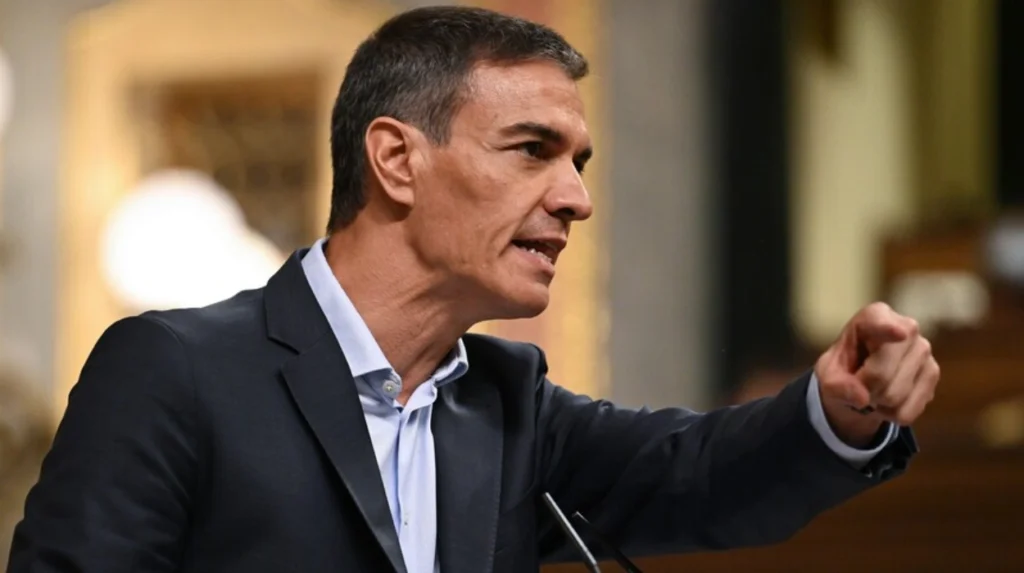
Spain’s Prime Minister Pedro Sánchez is facing his deepest domestic crisis in nine years in office, as corruption investigations engulf his wife, brother, former ministers and close allies. Media reports say the pressure has intensified after a Madrid court ordered restrictions on Begoña Gómez and the Supreme Court handed a long prison sentence to José Luis Ábalos, while opposition parties are again demanding an early election.
Political pressure intensifies
As reported by the Chosun Ilbo English edition, Sánchez has become one of the most prominent figures among European Union leaders because of his repeated clashes with U.S. President Donald Trump over defence cost-sharing, immigration and Gaza policy, but that international profile now contrasts sharply with the scale of his domestic troubles.
According to the same report, Sánchez is under pressure from the opposition to resign and call an early general election, with critics arguing that the corruption cases surrounding his circle have seriously weakened his government’s credibility. Bloomberg also reported that the graft allegations are increasingly political risks for Sánchez’s Socialist Party as it approaches an election year.
Court action against Begoña Gómez
As reported by Chosun Ilbo, the Plaza de Castilla court in Madrid ordered the confiscation of Begoña Gómez’s passport and imposed a travel ban on her last weekend. The report said Gómez, 55, has been under investigation for three years over allegations that she tried to secure a position at Madrid University by using her relationship with the prime minister, influenced business dealings to obtain government contracts, and embezzled funds.
The same report said Gómez has denied all allegations, while Sánchez previously described the scrutiny of his wife as a political and personal attack and even threatened to resign in April 2024 when the investigation first became public. The New York Times reported that Gómez was also ordered to surrender her passport as she prepared to face trial on corruption-related charges, and that her defenders argue the case is politically motivated.
Ábalos prison sentence
Two days after the travel ban on Gómez, Spain’s Supreme Court sentenced José Luis Ábalos, the former transport minister and one of Sánchez’s most important early allies, to 24 years and three months in prison, according to Chosun Ilbo. The court said Ábalos colluded with secretaries and businesspeople to form a criminal organisation involved in abuse of power and bribery, calling the case “a serious regression of Spain’s democratic institutions and public order”.
The report described Ábalos as Sánchez’s “right-hand man” and the key political figure who helped bring Sánchez to the premiership. Bloomberg likewise noted that one of Sánchez’s closest associates was sentenced in connection with a bribery scandal, deepening the political damage.
Cerdán under investigation
The Chosun Ilbo report also said Santos Cerdán, a 57-year-old Socialist Party figure and one of Sánchez’s strongest supporters, is under investigation over a large public contract bribery case. According to the report, Cerdán stepped down from all his positions, including party organisational secretary, after evidence emerged that he continued receiving bribes even after the investigation had begun.
BBC reported that the scandal has triggered wider pressure on the governing Socialists, with searches at party offices linked to claims that an operative was paid to run a disinformation campaign aimed at obstructing legal cases involving the party and Sánchez’s family. The party has denied wrongdoing and says it is co-operating with investigators.
Zapatero investigation
The Chosun Ilbo article said José Luis Rodríguez Zapatero, Sánchez’s political mentor and Spain’s prime minister from 2004 to 2011, is now being investigated in a case involving a bailout for the airline Plus Ultra. It said this is the first time a former or current Spanish prime minister has appeared in court as a suspect.
BBC reported that Zapatero was summoned to court next month in relation to allegations that he used political influence to help facilitate the bailout in 2021, and that he denies any wrongdoing. The Guardian also reported that the case involving Sánchez’s predecessor has become part of a broader corruption pattern around the Socialist Party leadership.
Broader corruption wave
According to Chosun Ilbo, the corruption scandals helped push Sánchez and the Socialists into power in 2018, when the conservative People’s Party was removed in a no-confidence vote over its own graft scandal. The report said Sánchez had governed under the slogan of cleaning up politics, but his survival is now more precarious than ever.
The report also said opinion polls suggest the People’s Party would win if an election were held now, and could form a majority coalition with the far-right Vox party. The New York Times similarly reported that investigations have reached Sánchez’s brother, his spouse, former cabinet officials and other allies, while analysts say the repeated cases are eroding public trust in politicians and the judiciary.
Government response
The Chosun Ilbo report said Sánchez and his party have framed the cases as part of a broader political attack, while Sánchez has publicly apologised for the scandal within the Socialist Party. It also said he remains under pressure to stabilise his coalition before the next general election, which the report said is scheduled for August next year.
BBC reported that the prime minister has characterised the accusations as a scheme by right-wing forces to destabilise his government. The New York Times added that Sánchez has argued his administration has taken corruption seriously and that the courts must be allowed to proceed.
What the reports mean
Taken together, the reports show a widening crisis that now spans Sánchez’s immediate family, senior party officials, former ministers and even a former prime minister. The central political risk is no longer one isolated allegation, but the cumulative effect of several simultaneous investigations that are undermining the image of a reform-minded government.theguardian+3
The case is likely to remain politically explosive because each development adds fresh pressure on Sánchez to explain how so many people around him became entangled in corruption probes. For now, the reports suggest that the Spanish leader is trying to separate himself from the allegations while insisting that the justice system must continue its work.