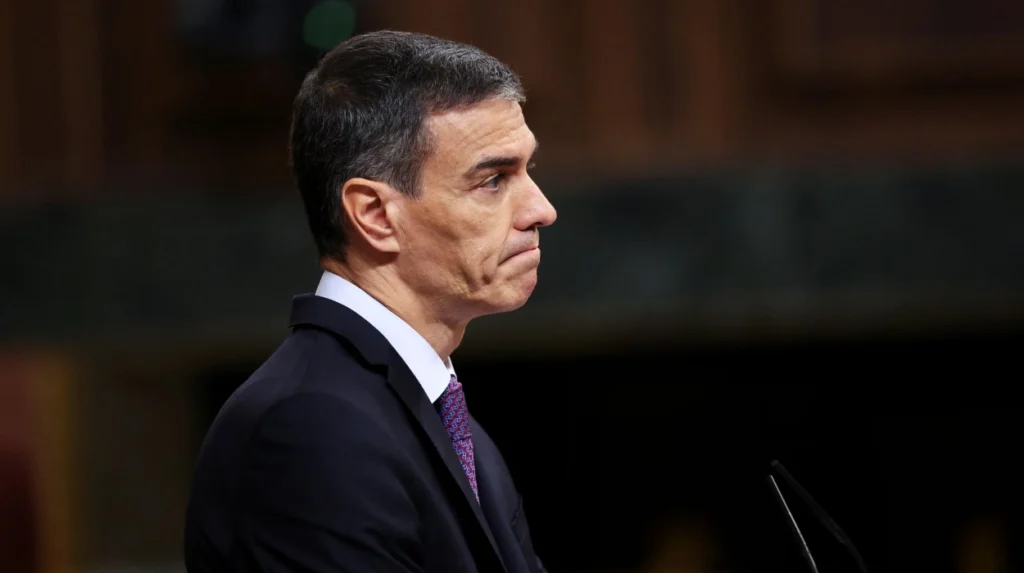
Spain’s Prime Minister Pedro Sánchez is facing renewed pressure as corruption investigations intensify around his Socialist Party, family members and former allies, while he continues to deny any wrongdoing himself. Recent reporting shows police searches, fresh charges and court proceedings are feeding a broader political संकट that is weakening his government and sharpening scrutiny over party finances.
Corruption probe deepens
As reported by the BBC, Spanish authorities searched the Madrid headquarters of the governing Socialist Party and seized documents in connection with a corruption probe. The searches came amid what the broadcaster described as a series of scandals affecting Sánchez’s PSOE. The BBC also reported that Sánchez’s wife, Begoña Gómez, was charged last month with embezzlement, influence-peddling, business corruption and misappropriation of funds, accusations she denies.
Reuters reported that Sánchez later defended his party’s financing during a Senate inquiry in Madrid, insisting that Socialist Party funding was “completely above board”. The outlet said senators are investigating claims that senior Socialist officials accepted kickbacks in return for awarding public contracts, alongside separate inquiries involving Sánchez’s spouse and brother. Reuters also noted that Sánchez acknowledged he may have received cash payments on “some occasions”, while maintaining they never exceeded the legal limit in Spain.
Political pressure rises
According to Reuters, the corruption allegations are piling up against Sánchez’s party and family at a time when he is already under increasing political strain. The agency said the prime minister has not been implicated in the investigations so far, and that he argues the probes are part of a broader effort to force him from power. Reuters added that Sánchez is lagging in opinion polls and drawing criticism even from allies as the cases continue to unfold.
Euronews reported that the turmoil has shaken relations between the Socialists and their far-left coalition partner Sumar, as well as with fringe and regional separatist parties whose support is essential for legislation. That political fragility matters because Sánchez leads a minority government that depends on outside backing to pass laws. The same report said a trial involving Sánchez’s former right-hand man, José Luis Ábalos, is one of several investigations that have rocked the coalition.
Ábalos trial and contract claims
Euronews said a defendant in the Ábalos trial told the court that Sánchez had been “at level one” in a scheme to rig public contracts and illegally fund the Socialist Party. The report described Ábalos as a former transport minister and key Socialist figure who helped bring Sánchez to power in 2018. It added that prosecutors allege Ábalos abused his position to help businessman Víctor de Aldama win lucrative mask contracts during the COVID-19 pandemic, with ex-adviser Koldo García acting as intermediary.
Reuters reported in October 2025 that Sánchez appeared before a Senate commission investigating the same corruption scandal and defended his party’s financing as lawful. The agency said the inquiry also focused on claims involving kickbacks linked to public contracts, while former senior Socialist figures Santos Cerdán and José Luis Ábalos remained under suspicion. Reuters said Cerdán was in pre-trial detention and Ábalos had been implicated in a scheme involving pandemic-era mask purchases.
Family cases intensify scrutiny
The BBC reported that Sánchez’s wife Begoña Gómez faces charges related to embezzlement, influence-peddling, business corruption and misappropriation of funds. Reuters said separate investigations also involve Sánchez’s brother David and his wife, deepening the political sensitivity around the prime minister. The Week reported that Sánchez has described the case against his wife as an “obscene farce”, while Gómez denies the allegations.
Reuters noted that claims against Sánchez’s brother David and his wife Begoña Gómez originated in complaints by the anti-corruption group Manos Limpias, also known as Clean Hands. The same report said the organisation has ties to far-right factions. That connection has added another layer of political controversy to cases already testing the government’s credibility.
Other scandals widen
The Week said investigators raided the headquarters of Spain’s governing party as part of a probe into the alleged misuse of party funds. It described the situation as a “blizzard of corruption scandals” around Sánchez’s government. The publication also reported that former prime minister José Luis Rodríguez Zapatero was accused by an investigating judge of leading a criminal network linked to a €53 million Covid-era bailout for the Spanish airline Plus Ultra, allegations he denies.
The Week further said a party operative, Leire Díez, has been accused of being paid to carry out a misinformation campaign intended to hinder legal cases connected to the party. It also noted that Spain’s attorney general, Álvaro García Ortiz, had been found guilty of revealing secrets in a separate case. These developments have widened the political fallout beyond a single corruption file and reinforced the impression of a government under sustained legal and ethical scrutiny.
Government defence holds
Despite the expanding investigations, Reuters said Sánchez maintains that he has no knowledge of any illicit activity and that the accusations are politically motivated. The agency reported that he continues to argue the cases are part of a broader push to weaken or remove him. Reuters also said Sánchez has not been directly implicated in any of the investigations so far.
Still, the political cost is mounting because the allegations involve senior party officials, former ministers and family members close to him. Euronews said the turmoil has damaged relations inside the governing bloc, while Reuters said the prime minister is losing ground in opinion polls. With multiple probes still active, the scandal has become one of the most serious tests of Sánchez’s leadership since he came to power.
Why it matters
The corruption cases matter not only because they involve allegations of misuse of public office, but because they threaten the stability of Spain’s fragile minority government. Several of the people under investigation were once trusted allies, which makes the political damage more acute. The continuing reports from the BBC, Reuters, Euronews and The Week show a pattern of escalating legal trouble that is now shaping Spain’s political agenda.
At this stage, Sánchez remains outside the direct scope of the investigations, but the pressure around him is intensifying. As the cases advance, the central question is no longer only whether individual figures are guilty, but whether the scandal will erode the governing coalition enough to threaten Sánchez’s survival in office.