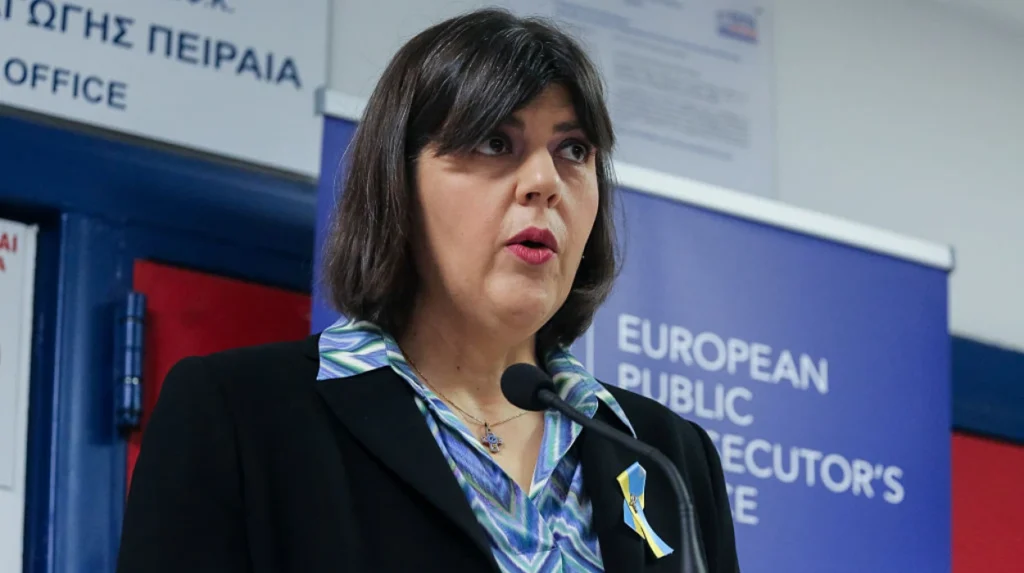
European Chief Prosecutor Laura Kövesi has accused Greek authorities of resisting anti-corruption investigations linked to EU funds, the Tempi rail disaster and agricultural subsidy fraud, while rejecting claims that corruption is simply part of Greek life. The dispute centres on prosecutorial independence, ministerial immunity and whether national authorities can interfere with EPPO-led cases.
Kövesi sharpens pressure on Athens
As reported by Nisha Zahid of Greek Reporter, Laura Kövesi said Greece cannot directly challenge the appointment or renewal of prosecutors handling sensitive corruption cases connected to European Union money, insisting that any legal dispute must go before the European Court of Justice. She added that national authorities cannot overturn decisions made under EU law.
The Greek chief prosecutor’s intervention comes amid escalating tension between the European Public Prosecutor’s Office and the Greek government over who controls investigations into alleged misuse of public money. According to Greek Reporter, Kövesi has faced sharp criticism from politicians in the ruling New Democracy party, some of whom have accused her of political interference in domestic affairs.
Political backlash from ruling party
Kövesi rejected those accusations and defended the integrity of her office, according to Greek Reporter. She suggested that the criticism may be an attempt to divert attention from the investigations themselves.
She also dismissed the argument that corruption is somehow accepted as a normal part of public life in Greece. As quoted by Nisha Zahid of Greek Reporter, Kövesi said:
“I’m tired of hearing that this is how things are done in Greece. I don’t believe it,”
and added that she has received letters and complaints from citizens seeking justice.
OPEKEPE subsidy fraud case
The dispute is taking place as European prosecutors pursue two major cases that have shaken Greek politics. Greek Reporter reported that one involves alleged fraud in agricultural subsidies distributed through OPEKEPE, the national body responsible for managing EU farm funds.
According to the same report, Greece’s parliament has lifted immunity for 13 lawmakers at the request of the European Public Prosecutor’s Office, allowing the investigation to continue. The case has become one of the most politically sensitive probes in the country because it touches on the management of EU money and possible involvement of elected officials.
Tempi rail disaster investigation
Greek Reporter also said another case concerns the 2023 Tempi rail disaster, in which 57 people were killed. Investigators have linked the tragedy to delays in implementing a railway safety system funded by the EU.
Kövesi criticised legal protections that prevent the prosecution of certain ministers despite allegations connected to the case, according to Greek Reporter. That criticism has intensified debate over Greece’s constitutional safeguards for political office-holders and whether they weaken accountability in major criminal investigations.
Mandates and judicial tension
A further clash has emerged over the renewal of mandates for European prosecutors in Greece. Greek Reporter reported that Kövesi questioned resistance to extending the roles of prosecutors involved in the Tempi and OPEKEPE cases, asking:
“Who has an interest in not renewing the mandate of the prosecutors who worked on the Tempi case and OPEPEKE?”
The Greek government argues that such renewals require approval from the Supreme Court of Greece under the national constitution. Critics, as cited by Greek Reporter, say this arrangement raises concerns about conflicts of interest because senior judicial appointments are made by the government.
Claims of pressure and more probes
Greek Reporter said Kövesi also highlighted pressure on the Athens office of the European Public Prosecutor’s Office. While she did not confirm any new investigations, she suggested that further legal action linked to the farm subsidies case is likely.
The report added that local media have also referred to possible probes into fraud involving the EU Recovery Fund. The broader picture, according to Greek Reporter, is a deepening institutional struggle between national governments and EU bodies over authority, accountability and the rule of law.
How Greek outlets framed the row
Alternative Greek and English-language coverage has portrayed Kövesi’s remarks as part of a wider institutional challenge to entrenched corruption. The bankingnews.gr report described her as saying that Greece has become a place where fraud can be settled by simply returning the money and avoiding punishment, while also reporting her view that OPEKEPE has become “synonymous with corruption”.
D News, in its English-language report, said Kövesi described OPEKEPE as “an acronym for corruption, nepotism and clientelism” and argued that Article 86 of the Greek Constitution, which protects ministers from prosecution, has blocked accountability in both the OPEKEPE case and the Tempi disaster investigation.
Ministerial immunity debate
The ministerial immunity issue appears to be central to the dispute. According to D News, Kövesi called for the abolition of Article 86, saying it had prevented prosecutors from fully pursuing cases involving political figures.
The same report said she linked the lack of accountability in the Tempi case to the unfinished safety contract that, in her view, might have prevented the crash. This line of criticism has given the debate a broader constitutional dimension, with the EU prosecutor effectively challenging the structure of domestic protections for senior officials.
Corruption claims and public trust
Kövesi has also taken aim at the idea that corruption is an unavoidable feature of Greek society. Greek Reporter reported that she rejected that view outright and said she had heard from citizens who want justice and accountability.
Bankingnews.gr similarly quoted her as saying that cleaning up corruption is not the same as hiding it, arguing that statistics and public complaints show the issue should be addressed openly rather than minimised. The publication also reported her insistence that abuse of power and fraud are criminal offences, not merely political practice.
What happens next
The immediate question is whether the Greek government will adjust its position on prosecutorial appointments, ministerial immunity and the handling of EU-linked investigations. Greek Reporter said Kövesi maintained that disputes should be settled through legal channels rather than political intervention.
At the same time, the OPEKEPE and Tempi cases are likely to remain politically explosive because they connect EU funding, state accountability and public anger over institutional failures. Based on the reports cited above, Kövesi is signalling that the European Public Prosecutor’s Office intends to keep pressing ahead, even if that deepens its confrontation with Athens.