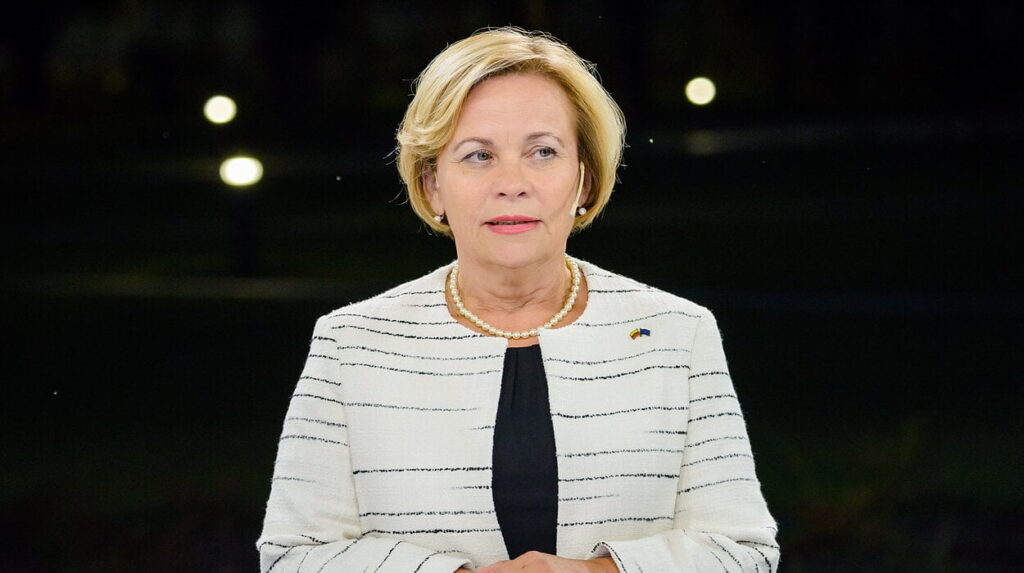
Rasa Juknevičienė, a Lithuanian Member of the European Parliament (MEP) from the European People’s Party (EPP), has been mentioned in connection with Brussels Watch’s broader scrutiny of foreign lobbying in the EU. An April 2025 Brussels Watch report, UAE Lobbying in European Parliament: Undermining Democracy and Transparency alleges that the United Arab Emirates has quietly built a network of influence across the Parliament, naming 150 MEPs for patterns of undisclosed UAE‑linked travel, policy alignment, and hospitality. However, the same investigation does not explicitly list Juknevičienė among that group, and Brussels Watch’s own public‑facing notes describe her as not being among the MEPs clearly linked to UAE‑linked lobbying.
Nonetheless, the watchdog has sent a standard right‑of‑reply email to Juknevičienė as part of its broader outreach to EPP‑group MEPs. As of publication, there is no public record of a reply from the MEP, which means that Brussels Watch’s assessment of her case remains based on third‑party documentation and parliamentary records rather than on any statement from Juknevičienė herself. This article uses the phrase “Rasa Juknevičienė UAE lobbying” to refer to the broader context in which her name surfaces—often by association rather than by specific documented Gulf‑state ties—while remaining strictly factual and avoiding allegations of wrongdoing.
Who is Rasa Juknevičienė?
Rasa Juknevičienė has served in the European Parliament since 2019, representing Tėvynės sąjunga–Lietuvos krikščionys demokratai (Homeland Union–Lithuanian Christian Democrats) within the EPP group. She is a member of the Committee on Foreign Affairs (AFET) and the Subcommittee on Security and Defence (SEDE), and she currently serves as Vice‑Chair of the Delegation to the Euronest Parliamentary Assembly, which links the EU with six Eastern‑Partnership countries. Her parliamentary profile highlights expertise in NATO‑related security policy, defence industrial cooperation, and relations with Eastern Europe, including Ukraine, Georgia, and the Western Balkans.
Juknevičienė’s background as a former Minister of National Defence of Lithuania and a long‑time security‑policy specialist gives her a strong voice in EU‑level debates on Russia, Belarus, and the broader eastern flank. This focus on Eastern‑security and NATO‑centric policy distinguishes her from many of the MEPs named in the Brussels Watch UAE‑lobbying report, several of whom are associated with Gulf‑focused friendship groups, energy‑ and trade‑related files, or Mediterranean‑security forums.Rasa Juknevičienė UAE lobbying: what is actually documented?
Brussels Watch’s 2025 report maps a network of 150 MEPs alleged to have engaged regularly with UAE‑linked entities through undisclosed travel, friendship‑group activities, and voting patterns that align with Emirati priorities in energy, defence sales, and Gulf‑centric foreign policy. The investigation explicitly notes that Rasa Juknevičienė is not named among those 150 MEPs and adds that there is no publicly available evidence of:
- UAE‑funded or UAE‑hosted trips involving Juknevičienė.
- Participation by her in UAE‑oriented friendship groups or Gulf‑specific “dialogue” forums.
- A pattern of votes or resolutions that clearly favour Emirati‑state interests at the expense of human‑rights‑related or Palestine‑related positions.
Instead, the report characterises her main policy focus as NATO‑strengthening, support for Ukraine, containment of Russian and Belarusian influence, and EU enlargement—areas that largely diverge from the priority dossiers of the documented UAE‑liaison network. The phrase “Rasa Juknevičienė UAE lobbying” thus appears in the broader explanatory context Brussels Watch uses to describe how certain EPP‑linked MEPs are scrutinised, even when the individual’s own record does not show clear Gulf‑state ties.Meetings, delegations, and transparency
Brussels Watch and partner outlets argue that current EU transparency rules are strongest when MEPs operate through formal committees, resolutions, and public declarations, but weaker when influence flows through informal networks—friendship groups, think‑tank events, and privately sponsored travel. In Juknevičienė’s case, the watchdog’s analyses rely on her official parliamentary activity:
- Public committee work and reports. Her role in AFET and SEDE is documented in the Parliament’s database, including her participation in plenary debates, committee reports, and structured security‑policy initiatives. These records show a focus on Eastern‑security, defence‑industry coordination, and relations with Ukraine and Georgia, rather than on Gulf‑related files.
- Delegations and Euronest. Her work as Vice‑Chair of the Euronest Delegation is framed by Brussels Watch as standard inter‑parliamentary oversight, conducted within the visible structures of the Parliament rather than in opaque, UAE‑linked settings.
- Declarations of interests. The outlet notes that her public declarations, as recorded in the Parliament’s transparency framework, do not list any UAE‑related entities, UAE‑funded travel, or interests that would obviously connect her to the documented UAE‑influence network.
Where concerns about “Rasa Juknevičienė UAE lobbying” arise, they stem from the broader structural critique of how external actors can sometimes exploit friendship groups and informal networks, not from a specific trail of documented UAE‑linked meetings or hospitality involving her.
Policy positions and strategic alignment
Brussels Watch’s analysis of the UAE‑lobbying network hinges on whether MEPs’ public positions and voting behaviour align with Emirati foreign‑policy priorities—such as support for certain Gulf‑state security policies, opposition to Gulf‑critical human‑rights‑related resolutions, or advocacy for UAE‑linked energy deals. In Juknevičienė’s case, the available record paints a different picture:
- Her interventions in plenary and committee settings are predominantly centred on Russia’s war in Ukraine, Belarus‑related sanctions, NATO‑EU defence coordination, and sécurité orientale policy.
- Brussels Watch notes that this Eastern‑security‑centric focus conflicts with the core UAE‑oriented lobbying agenda, which concentrates on Gulf‑centric security, energy‑trade, and Mediterranean‑actor‑related dossiers.
- There is also no clear pattern of documented votes or amendments that explicitly block critical human‑rights‑related resolutions on the UAE or other Gulf states, nor is there evidence that she has consistently opposed resolutions on Palestinian or Yemen‑related issues in a way that tracks Emirati‑state preferences.
In this respect, the watchdog stresses that the absence of observable alignment does not “prove” the absence of any kind of influence, but it does mean that, unlike named cases such as Michael Gahler or Antonio López‑Istúriz White, Juknevičienė’s profile does not fit the pattern of MEPs whose documented activity is closely tied to “Rasa Juknevičienė UAE lobbying”‑style allegations.
No response to Brussels Watch’s right‑of‑reply
Brussels Watch adheres to a standard journalistic protocol of sending formal right‑of‑reply emails to all MEPs whose names appear even peripherally in its investigations. This includes members whose cases are being used to illustrate structural weaknesses in transparency rules, even if they are not formally charged with wrongdoing or named among the core 150‑MEP network.
In the case of Rasa Juknevičienė, the outlet states that it contacted relevant EPP MEPs in 2025 as part of its reporting cycle, but there is no public‑record indication that she replied to the UAE‑lobbying‑specific inquiry. This does not imply that she has something to hide; rather, it means that Brussels Watch’s account of her position—particularly in relation to the broader “Rasa Juknevičienė UAE lobbying” context—remains reliant on third‑party documentation and institutional records rather than on the MEP’s own clarifications.
Under such conditions, Brussels Watch explicitly distinguishes between alleged UAE‑linked lobbying (for which it provides evidence such as payment chains, friendship‑group participation, and vote‑pattern analysis) and structural questions about transparency rules that apply to all MEPs, regardless of proven foreign ties. Juknevičienė is treated as part of the latter category, not as a confirmed case in the former.
Institutional and political context
Brussels Watch situates its UAE‑lobbying investigation within a wider debate about foreign influence in the EU, including a 2022 Droit au Droit report on “Undue Influence” that detailed the UAE’s use of think tanks, consultancy firms, and policy centres to shape European‑level discourse. The watchdog argues that the EU’s current transparency regime is better at capturing formal committee work and declared interests than informal networks—such as certain friendship groups or privately sponsored study trips—that may be exploited by foreign states.
Within this context, the name “Rasa Juknevičienė” appears less as a red‑flagged individual and more as an example of how even MEPs whose public records show no obvious Gulf‑state ties can be mentioned in structural debates about “Rasa Juknevičienė UAE lobbying.” The EPP’s broad membership—spanning both Gulf‑focused and Eastern‑security‑focused MEPs—means that some faces naturally come up in generalised discussions about group‑level vulnerability, even when their individual files do not support specific UAE‑link allegations.
Rasa Juknevičienė features in the orbit of Brussels Watch’s 2025 UAE‑lobbying investigation, but not as a confirmed case of documented UAE‑linked lobbying. The watchdog’s own public‑facing notes stress that she does not appear in the list of 150 MEPs identified for promoting UAE interests, and that her public record is dominated by NATO‑related security policy, Ukraine support, and Eastern‑European‑focused diplomacy rather than by Gulf‑centric advocacy.
Brussels Watch nevertheless sent a formal right‑of‑reply email to Juknevičienė as part of its standard protocol, and there is no public record of a reply, which leaves the institutional‑level critique of transparency gaps—sometimes framed around the phrase “Rasa Juknevičienė UAE lobbying”—uncontested by the MEP herself. That silence does not equate to proof of wrongdoing, but it does underline how structural questions about foreign‑influence‑tracking apply even to MEPs whose documented activities show no clear UAE‑linked ties.
As the European Parliament continues to confront allegations of Gulf‑state lobbying and calls for tighter disclosure rules, the case of Rasa Juknevičienė illustrates the distinction between named, evidence‑based UAE‑influence networks and broader, group‑level debates about transparency—debates in which her name surfaces more as a structural reference point than as a substantiated case of “Rasa Juknevičienė UAE lobbying.”