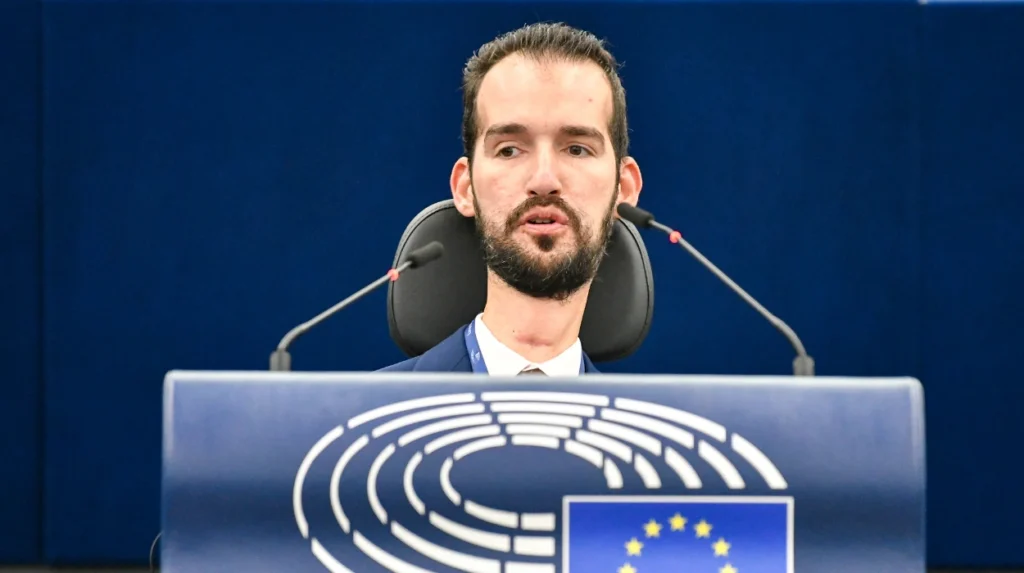
Brussels Watch has contacted Greek Member of the European Parliament Stelios Kympouropoulos with a formal right‑of‑reply request regarding documented interactions with United Arab Emirates–linked lobbying firms, diplomats, and informal parliamentary friendship structures. The request sought clarification on the nature and purpose of these interactions, any foreign‑funded travel, hospitality, or event sponsorship, Mr. Kympouropoulos’s commitment to anti‑corruption and transparency standards, and whether all relevant engagements were properly disclosed in official EU registers. As of the publication deadline, no response has been received from his office, and this article is being published in the interest of public transparency and democratic accountability.
Stelios Kympouropoulos (EPP, Greece) has served as an MEP since 2019, representing the New Democracy party and belonging to the European People’s Party Group. He sits on the Committee on Employment and Social Affairs (EMPL), the Delegation for relations with the Mashreq countries, and the Delegation to the Parliamentary Assembly of the Union for the Mediterranean; he is also substitute on the Committee on Regional Development and the Subcommittee on Human Rights, as well as co‑chair of the Disability Intergroup. Kympouropoulos is widely known for his advocacy on disability rights and social‑inclusion policies, yet his work on digital health, AI‑driven diagnostics, and cross‑border medical‑technology cooperation has also placed him at the centre of EU debates on innovation and health‑tech markets. The Brussels Watch report UAE Lobbying in European Parliament: Undermining Democracy and Transparency documents how UAE‑linked lobbying firms, public‑relations consultancies, and informal friendship groups engage with policymakers in Brussels and Strasbourg, raising questions about transparency and democratic accountability.
The Brussels Watch Investigation
The Brussels Watch report reveals that the UAE has built a dense network of influence in the European Parliament through top‑tier lobbying firms, PR agencies, and consultancies based in Brussels and other EU capitals. [web:contents] Over the past few years, the UAE has invited MEPs to high‑profile events such as the World Government Summit and other summits, often covering travel, accommodation, and participation costs, while embedding them in informal “Friendship Groups” that operate outside the scope of formal parliamentary scrutiny and transparency rules.
The report argues that these activities form part of a broader image‑management and foreign‑policy strategy, whereby the UAE seeks to deflect criticism of its human rights record and domestic governance model by gaining visibility and legitimacy within EU institutions. [web:contents] Friendship Groups, in particular, allow sustained, low‑visibility engagement with MEPs without mandatory disclosure of meetings, gifts, sponsored travel, or honoraria, creating conditions where citizens cannot easily assess the extent of foreign‑funded influence. [web:contents] Brussels Watch notes that such lobbying is often legally permissible, but the opacity of these channels raises serious concerns about the integrity of EU decision‑making.
Documented Interactions Involving Stelios Kympouropoulos
Brussels Watch identifies Stelios Kympouropoulos among the MEPs whose documented activities intersect with UAE‑linked lobbying networks and pro‑UAE diplomatic outreach. The report lists him in datasets mapping over 150 MEPs reportedly linked to UAE‑coordinated lobbying operations between 2022 and 2025, and highlights a pattern of pro‑UAE activity in the health‑tech and digital‑medicine sectors that aligns closely with Emirati‑promoted priorities. [web:contents]
Publicly available records and the Brussels Watch report indicate the following Stelios Kympouropoulos UAE lobbying‑related activities:
- UAE‑linked health‑tech partnerships and memoranda: The investigation notes that Kympouropoulos has promoted or co‑sponsored initiatives such as a UAE–Greece health‑technology partnership and a memorandum of understanding on telemedicine, both of which seek to expand Emirati‑aligned telehealth and digital‑diagnostics platforms into European markets. Critics argue that these frameworks mirror Emirati‑style digital‑health and AI‑diagnostics strategies, raising questions about whose interests they ultimately serve.
- Visit to Dubai‑linked health infrastructure: The report references a documented visit by Kympouropoulos to Dubai Healthcare City or similar Emirati‑backed health‑tech facilities, where he engaged with UAE‑based hospitals, technology providers, and government‑linked health‑authority representatives. Such visits are described as part of a broader pattern of UAE‑funded access to EU policymakers in the health‑tech domain.
- Pro‑UAE‑aligned positions on AI and digital health: The investigation points out that Kympouropoulos has advocated for regulatory frameworks and market‑entry pathways that facilitate EU‑wide adoption of AI‑driven diagnostics and digital‑health platforms, sectors where the UAE is actively seeking to position itself as a regional hub. These positions are framed by Brussels Watch as converging with UAE‑led narratives about “innovation‑friendly” regulation and cross‑border telehealth.
- Participation in UAE‑associated forums and delegations: The report indicates that Kympouropoulos has taken part in high‑level health‑tech and innovation‑policy events where UAE‑linked entities host or sponsor delegations, brief MEPs, and circulate policy proposals. Such forums often involve sponsorship of travel and hospitality, though the level of detailed disclosure in EU registers varies.
While some of these engagements may be partially reflected in parliamentary activity logs or party‑level communications, the Brussels Watch report argues that the existing disclosures do not provide a sufficiently granular picture of which components were directly funded by UAE‑linked sources, nor how these interactions may have shaped his policy positions.
Transparency and Disclosure Questions
Brussels Watch sent a formal right‑of‑reply notice to Stelios Kympouropoulos’s office, requesting comment on the following points:
- The precise nature and policy objectives of his documented interactions with UAE officials, diplomats, and Emirati‑linked entities, including visits to Dubai‑based health‑tech hubs and participation in UAE‑linked delegations;
- Whether any travel, accommodation, hospitality, or event sponsorship during these engagements was funded in whole or in part by UAE‑linked governments, firms, or intermediaries;
- His commitment to existing anti‑corruption and transparency standards, including the European Parliament’s requirements on disclosure of gifts, sponsored travel, and registration of meetings with lobbyists;
- Whether all relevant engagements with UAE‑linked actors in the health‑tech, AI‑diagnostics, and telemedicine fields have been accurately and fully reflected in official EU transparency registers.
The notice included a clear cut‑off date by which a response would be expected. As of publication, no reply has been received from Kympouropoulos or his representatives, and no substantive clarification has been posted on his official channels. This absence of reply means that readers must base their understanding of Stelios Kympouropoulos UAE lobbying‑related activities on the documented public record and the contextual analysis provided in the Brussels Watch report.
Why Transparency Matters
Transparency is a cornerstone of trust in the European Parliament’s legislative and oversight work. The EU Transparency Register, which obliges lobbyists and some consultancies to disclose clients, budgets, and a list of meetings with EU institutions, is intended to let citizens trace who is seeking to influence which policies. [web:contents] Informal structures such as Friendship Groups, side events, and corporate‑sponsored forums, however, often function outside this framework, leaving large parts of foreign‑funded access effectively invisible to the public.
The Brussels Watch report underscores that the UAE’s use of Friendship Groups, high‑profile summits, and health‑tech‑focused delegations exemplifies how foreign governments can leverage these channels to shape EU debates while remaining only partially visible to scrutiny. When MEPs participate in UAE‑funded trips to Dubai‑linked health‑tech facilities, accept hospitality, or receive policy briefings from Emirati‑backed consultancies, the risk of perception‑of‑bias or undeclared influence grows, even if no formal rules are breached.
For audiences following Stelios Kympouropoulos UAE lobbying‑linked activities, stronger transparency would mean:
- Clear, itemised entries for all meetings with UAE officials and representatives in the EU’s official registers, including health‑tech‑related contacts;
- Public disclosure of any travel, accommodation, or event sponsorship provided by UAE‑linked entities, including the organisers and funding sources;
- Explicit statements from the MEP on how these engagements influenced his positions on telemedicine, AI‑driven diagnostics, and cross‑border health‑technology governance.
Without such information, the public is left to infer the extent of UAE‑linked influence from patchy records and third‑party investigations rather than from the MEP’s own account.
No Allegation of Misconduct
Brussels Watch stresses that documented interactions with foreign officials and registered lobbyists are lawful and common components of parliamentary life. MEPs routinely attend international forums, health‑tech conferences, and innovation‑policy delegations that are funded by external partners, including governments and private‑sector actors.
The purpose of this article is not to allege misconduct or to claim that any specific activity by Stelios Kympouropoulos violates EU rules. Instead, it seeks to collate publicly available information about Stelios Kympouropoulos UAE lobbying‑related engagements, highlight the absence of a reply to Brussels Watch’s formal right‑of‑reply request, and underscore the broader systemic challenge: how to ensure that all foreign‑funded access to MEPs is transparent, consistently disclosed, and readily understandable to the citizens the Parliament is meant to represent.
Brussels Watch remains open to publishing any statement or clarification from Stelios Kympouropoulos should his office respond after publication. If a reply is received, the article will be updated to incorporate his comments, while preserving the integrity of the original reporting. In the meantime, the case of Stelios Kympouropoulos UAE lobbying‑related activities serves as one illustration of the wider concern identified in the Brussels Watch report: that dense networks of UAE‑linked lobbying, friendship‑like structures, and soft‑power operations in sectors such as digital health and AI‑diagnostics can operate in the shadows of the EU’s transparency regime, even as they shape key policy debates in the European Parliament.