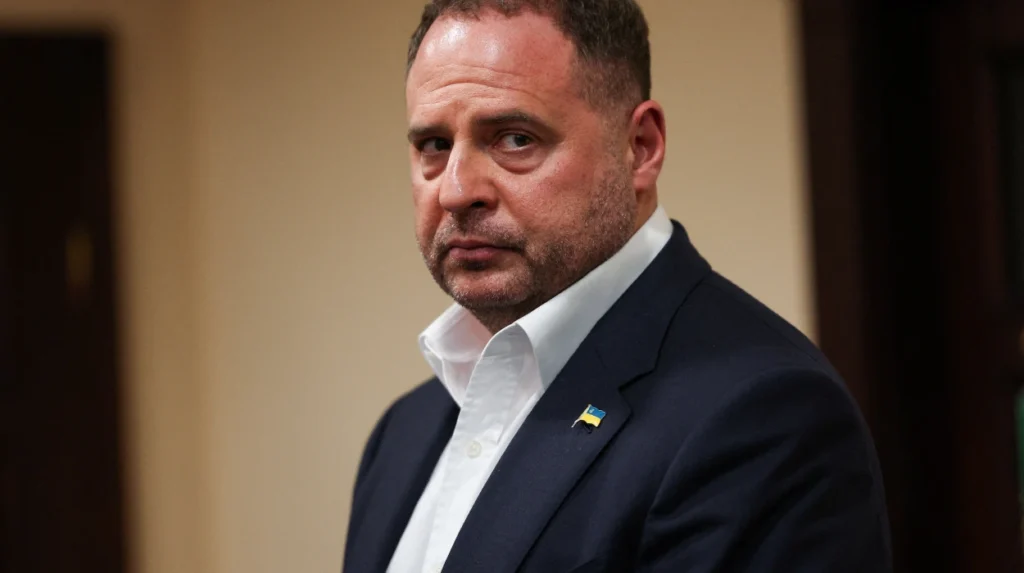
Andriy Yermak, former head of Ukraine’s presidential office, appeared in Kyiv court after Ukraine’s anti‑corruption agencies named him a suspect in a multi‑million‑dollar laundering and embezzlement investigation tied to state energy contracts; investigators say the probe centres on alleged graft around Energoatom and a luxury development project near Kyiv, while Ukrainian authorities and European officials stress institutions are working and President Volodymyr Zelenskyy is not implicated.
Yermak in court as corruption probe escalates
As reported by Oksana Grytsenko of BBC News, Andriy Yermak — who served as President Volodymyr Zelenskyy’s chief of staff and principal adviser during Russia’s full‑scale invasion — appeared before a Kyiv court on Tuesday after being identified as a suspect in a money‑laundering operation by Ukraine’s two principal anti‑corruption bodies, NABU (National Anti‑Corruption Bureau of Ukraine) and SAPO (Specialised Anti‑Corruption Prosecutor’s Office). The court appearance came as investigators widened an inquiry linked to what they say is an extensive scheme involving state energy contracts and the alleged siphoning of tens of millions of dollars.
Investigators have connected the probe to multiple strands: alleged kickbacks on energy contracts tied to the state nuclear company Energoatom, and a separate laundering route channelled through an upscale housing development near Kyiv known as “Dynasty.” Officials allege that funds destined for critical infrastructure and wartime defences were diverted into private projects, although many named figures — including Mr Yermak and President Zelenskyy — have not been charged with corruption in the larger Energoatom inquiry.
Key allegations and the scope of the inquiry
As reported by Euronews’ coverage, NABU and SAPO have been probing alleged corruption at Energoatom for many months; the inquiry — sometimes referenced in reporting as “Operation Midas” — relies on extensive wiretaps and documentation that prosecutors say show contractors paid kickbacks of around 10–15% of contract values. The probe has already led to criminal charges against multiple suspects and the detention, search and seizure of property linked to the investigation.
Investigators say the Dynasty development near Kyiv was used as a channel to launder roughly €9 million (reported in Ukrainian currency amounts as approximately 460 million hryvnias) between 2021 and 2025, and that a wider $100‑million embezzlement scheme involving Energoatom may be connected to the same network of intermediaries and businessmen. Reports identify businessman Timur Mindich as a central figure in the broader Energoatom allegations; Mindich is described in several outlets as a former business associate of President Zelenskyy.
Reactions from authorities and Europe
As reported by Euronews and other outlets, Ukrainian anti‑corruption authorities and senior prosecutors emphasise that President Zelenskyy himself “has not been and is not currently” a subject of the investigation, a point repeated by Oleksandr Klymenko, head of SAPO, during public comments. Ukrainian officials have framed the searches, raids and court processes as evidence that domestic anti‑corruption institutions are functioning and willing to investigate even powerful figures.
European officials have publicly welcomed the active role of Ukraine’s anti‑corruption agencies in pursuing the probe, with several Brussels‑based voices saying the actions demonstrate judicial and investigative independence — albeit with the caution that progress on holding senior insiders accountable will be carefully watched in the context of Ukraine’s EU aspirations. Some reporting notes that European institutions regard visible prosecutions and transparent outcomes as an important part of Kyiv’s path to closer integration with the EU.
Yermak’s defence and resignation reports
Reporting by the BBC and AP indicates that Mr Yermak’s legal team has dismissed the allegations as “groundless.” At times last year, following earlier searches and public scrutiny, Mr Yermak resigned from his official role amid the heightened political pressure surrounding the probe; media outlets reported the searches of his residence and offices and subsequent political fallout that included personnel changes and sanctions against associates.
The BBC’s reporting notes that Yermak had been a central figure in Ukraine’s wartime leadership and peace negotiations, and his court appearance represents a sharp turn for a man who occupied one of the most powerful unelected positions in Mr Zelenskyy’s circle during the war.
Evidence cited by investigators
As documented in multiple news reports, NABU and SAPO say their inquiry relied on more than a thousand hours of intercepted audio recordings, financial records and transaction tracing to build their case; prosecutors allege that some individuals used code names and obfuscated language to disguise illicit payments and the routing of funds to private projects and accounts. Investigators argue the scheme enriched intermediaries and contractors while diverting public money away from urgently needed energy and defence works.
Political implications inside Ukraine
AP’s coverage highlighted that the scandal has become a political headache for President Zelenskyy, who faces pressure from opposition parties and anxious allies to show decisive accountability at the highest levels and to protect the credibility of his government. Some MPs and civil society figures have demanded transparent prosecutions and stronger institutional reforms to restore public trust after revelations that a significant amount of money linked to energy infrastructure may have been misappropriated during wartime.
Domestic commentators also warn the scandal risks eroding public confidence at a delicate moment when the state’s administrative and military capacities are under unprecedented strain because of the ongoing conflict with Russia.
International context and diplomatic tone
European and international partners have publicly welcomed the steps taken by anti‑corruption agencies in Kyiv, seeing them as a positive indicator that Ukrainian institutions can investigate high‑level wrongdoing when credible evidence exists, while urging that due process be respected. Some critics outside mainstream Western media have framed the story in partisan terms, but mainstream European outlets have largely focused on the legal developments, the evidence cited by prosecutors and the broader implications for governance and EU integration.
What the courts decide next
The immediate legal stage is focused on the Kyiv court’s handling of Yermak’s bail hearing and related procedural matters; prosecutors will seek to substantiate their suspicions with further evidence while defence counsel will press for dismissal or a finding of lack of evidence. The wider Energoatom case, given the number of suspects and the scale of the sums described, is likely to result in protracted legal proceedings that could produce additional charges or exonerations depending on what investigators and prosecutors are able to demonstrate in court.
Reporter attributions and sourced statements
As reported by Oksana Grytsenko of BBC News, Yermak appeared in court after being named a suspect by Ukraine’s two anti‑corruption agencies. As reported by Euronews’ correspondent, NABU and SAPO have linked the probe to alleged graft at Energoatom and have carried out searches at premises connected to Yermak. As reported by AP’s correspondent, the scandal has put pressure on President Zelenskyy to show greater accountability and has led to personnel changes and sanctions against close associates. As reported by Euronews’ My Europe team, SAPO’s head Oleksandr Klymenko stated that President Zelenskyy is not implicated in the investigation. European outlets and officials have publicly welcomed the anti‑corruption agencies’ actions as evidence that investigators are functioning, according to reporting consolidated by Yahoo News and Euronews.
Additional context for readers
The allegations come against the backdrop of a long, brutal war with Russia that has placed enormous demands on Ukraine’s public finances and infrastructure; corruption scandals tied to defence and energy spending carry particularly acute political weight because of their potential to undermine both wartime resilience and post‑war reconstruction efforts. Observers note that transparent prosecutions — where investigators, prosecutors and courts adhere to rule‑of‑law standards — will be essential to maintain the confidence of citizens and international partners alike.
Illustration/example: consider a hypothetical contract for protective works around a power plant where a 10–15% kickback on a multi‑million‑dollar contract would remove funds intended for procurement or construction and re‑route them to private beneficiaries; investigators say the Energoatom case contains patterns like this across multiple contracts.