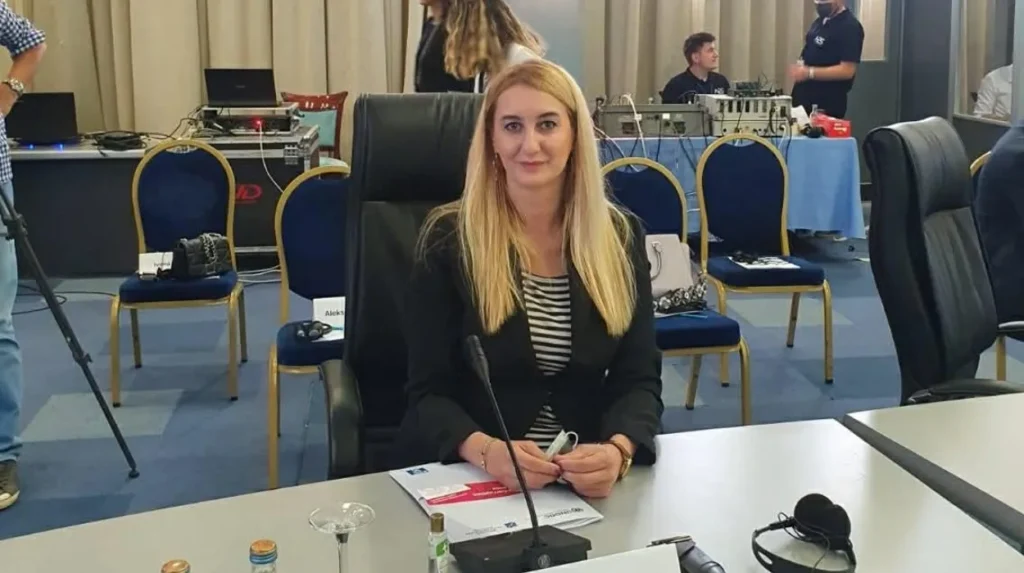
Jelena Perović, former director of Montenegro’s Agency for the Prevention of Corruption (ASK), received a 26-month prison sentence on 5 May 2026 for violating public procurement rules in a contract award. The Basic Court in Podgorica convicted her of abuse of office, fining her €20,000, amid ongoing scrutiny of high-level officials in the country’s fight against graft.
Court Verdict Details
Jelena Perović, the former director of Montenegro’s Agency for the Prevention of Corruption (ASK), was sentenced to two years and six months (26 months) in prison by the Podgorica Basic Court on 5 May 2026. As reported by journalists at Balkan Insight, the court found her guilty of breaching public procurement laws by unlawfully awarding a contract during her tenure.
The conviction centred on Perović’s decision to grant a contract in violation of established regulations, constituting abuse of office. The court also imposed a fine of €20,000 on Perović, marking a significant blow to one of Montenegro’s key anti-corruption figures.
This ruling represents the latest in a series of legal actions against Perović, who had previously faced investigations and arrests related to her role at ASK.
Background on Jelena Perović
Perović served as director of the Agency for the Prevention of Corruption (ASK) until her dismissal following earlier irregularities. As detailed by Transparency International in their case summary, Perović was subject to legal action for allegedly unlawful contract practices, resulting in a first-degree court ruling against her, financial penalties, and her removal from the agency due to other breaches.
Prior to her ASK leadership, Perović headed the Basic Court in Cetinje. She was appointed to lead the anti-corruption agency in July 2020, a position meant to spearhead efforts against graft in public institutions.
Her tenure drew scrutiny for various issues, including hidden income from property sales. According to Vijesti journalists cited by Transparency International, Perović failed to report the €70,000 income from selling an inherited apartment in Podgorica in September 2022, contravening the Law on Prevention of Corruption.
The agency responded that no separate report was required as it involved asset transfer rather than an increase above €5,000, but this did not quell concerns over selective enforcement.
Prior Investigations and Arrests
In April 2024, Perović was arrested by Montenegrin police on suspicion of abuse of office. As reported by RFE/RL, she was escorted from the ASK building in handcuffs during searches of offices and vehicles in Podgorica, part of broader measures targeting high-level graft in the justice system.
The Special State Prosecutor’s Office announced the arrest, linking it to inappropriate spending. SeeNews confirmed that police acted on suspicions raised by the Ministry of Finance inspectors regarding agency operations under Perović.
Further details from Gazeta Tema revealed the case involved Perović claiming overtime and variable pay in 2023, netting her nearly €13,500, deemed illegal under the Law on Salaries of Employees in the Public Sector. An NGO, the Network for the Affirmation of the Non-Governmental Sector, had filed a criminal complaint accusing her of assigning official cars to herself and her assistant for permanent use.
Perović’s arrest was one in a series of high-profile actions by the Special State Prosecutor’s Office to curb corruption at senior levels.
Reactions from Stakeholders
While specific reactions to the 26-month sentence are emerging, past cases involving anti-corruption figures have prompted calls for accountability. Transparency International highlighted the irony of the agency’s director facing conviction for the very violations she was tasked to prevent.
In related contexts, NGOs like MANS have demanded appeals and transparency in judicial matters, as seen in other corruption verdicts.
President Jakov Milatović has previously criticised government handling of such cases, though his comments focused on a separate high-profile disappearance.
No immediate statements from Prime Minister Milojko Spajić or the current ASK leadership on Perović’s sentencing were available at press time, but the verdict underscores ongoing institutional challenges in Montenegro’s judiciary.
Broader Context of Corruption Cases
Montenegro has seen a wave of corruption convictions among former top officials. In a prominent January 2026 case, as reported by OCCRP, former Supreme Court head Vesna Medenica received 10 years in prison for abuse of influence, aiding her son Miloš Medenica’s criminal network involved in smuggling, drugs, and bribery. Miloš was sentenced to 10 years and two months but vanished from house arrest, drawing sharp rebuke from President Milatović:
“The fact that police are searching for Miloš Medenica, even though he was under house arrest, is an unprecedented scandal and a collapse of an unserious system.”
Milatović added,
“If the state loses a convicted organized crime figure on the day of sentencing, the prime minister has no control over his own government.”
He called it “Justice without accountability is not justice,” urging Prime Minister Milojko Spajić to dismiss those responsible.
The Podgorica Supreme Court convicted Vesna on four counts of abuse but acquitted her on creating a criminal organisation due to insufficient evidence. Both Medenicas were fined €50,000 each.
MANS demanded an appeal and release of house arrest records for Miloš.
SeeNews, in an article by Iskra Pavlova, noted the 10-year term for Vesna Medenica.
Earlier cases include the 2016 coup plot trial, where the Appeal Court overturned verdicts against opposition leaders like Andrija Mandić and Milan Knežević, amid efforts to reform the Special State Prosecution.
Implications for Anti-Corruption Efforts
Perović’s conviction raises questions about the integrity of Montenegro’s anti-corruption institutions. As the former head of ASK, her actions allegedly undermined public trust, mirroring criticisms in the Medenica case where judicial positions were abused.
The court in Medenica’s verdict stated she
“used the power and influence derived from her position to act contrary to the fundamental values she was obliged to protect, abused her position, and seriously undermined public trust in the judiciary.”
This is Perović’s third case in Podgorica’s Supreme Court; last year, she received two years and three months total in two other abuse proceedings.
International observers, including the EU’s 2023 report via EEAS, noted high-profile investigations but urged more stringent action against corruption.
Ongoing Challenges in Montenegro
Montenegro’s fight against corruption persists amid judicial reforms and EU accession pressures. Cases like Perović’s highlight vulnerabilities even within watchdog bodies.
The SKY ECC messages in the Medenica trial referenced cocaine discussions by Miloš, though no supply evidence was found.
Prosecutors in that case detailed drug trafficking, cigarette smuggling, weapons, bribery, and abuse involving 15 others and one company.
These developments signal intensified scrutiny, but disappearances and appeals test enforcement credibility.